Full Stack Web Development Roadmap for Non-Tech Founders — 2026 Edition
34 min read
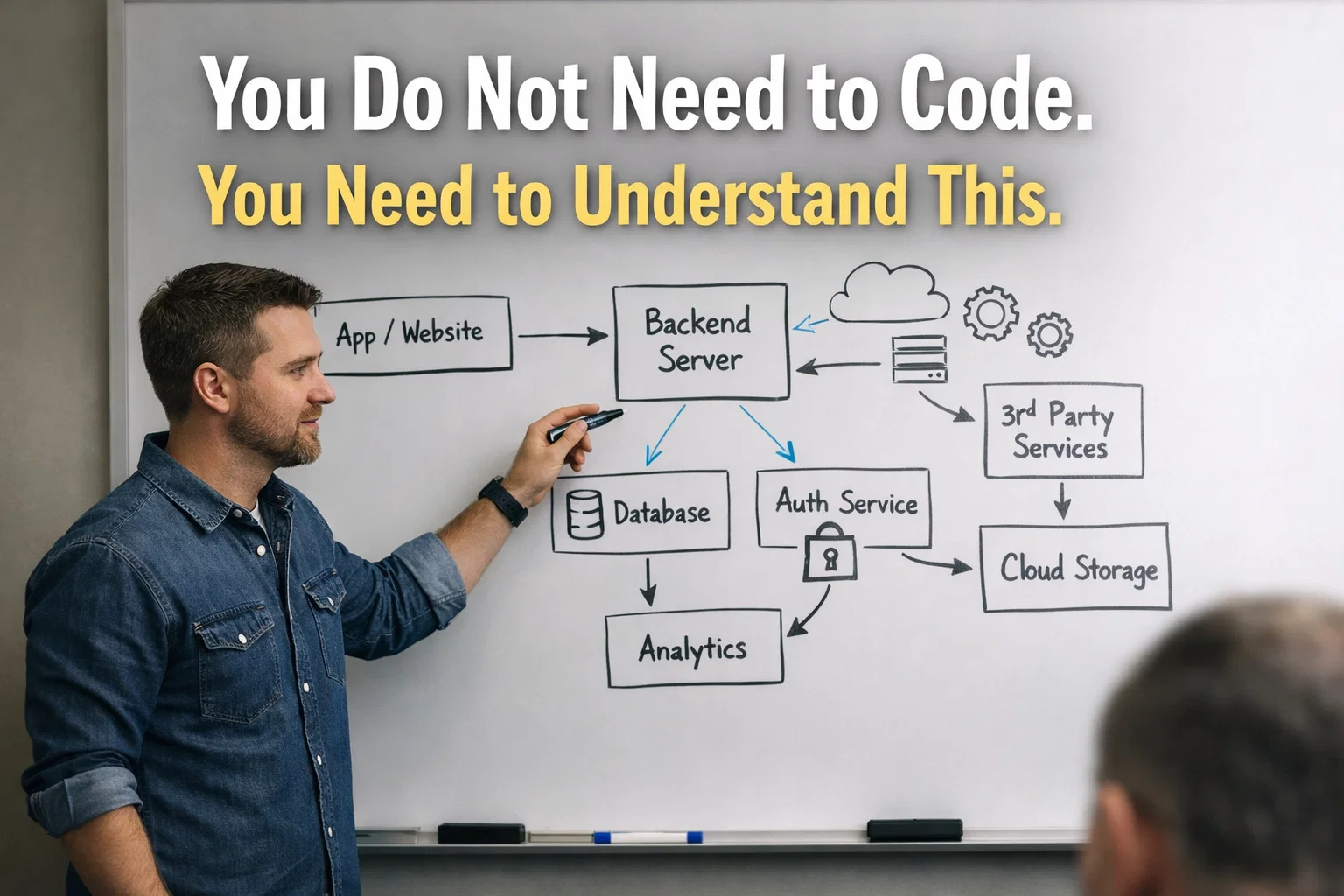
You do not need to code to build a great product. But you do need to understand the landscape. This 2026 roadmap gives non-tech founders the knowledge to lead,
Full Stack Web Development Roadmap for Non-Tech Founders — 2026 Edition
You have the idea. You understand the market. You know the problem your product will solve better than anyone else in the room.
What you do not have is a computer science degree — and you are about to hire a developer, commission a web agency, or try to evaluate a technical proposal. You need to make decisions that will shape your product for years. And you are doing it without the technical fluency to know whether what you are being told is right.
This is one of the most common and most costly positions a non-tech founder in India can find themselves in. It is also entirely avoidable.
You do not need to learn to code. But you do need to understand the landscape well enough to ask the right questions, evaluate the answers, spot when you are being misled, and make confident decisions about your product's technical direction.
This guide is the full stack web development roadmap written specifically for non-tech founders in India in 2026. It covers what the technology actually is, what decisions you will need to make and when, how to work effectively with developers, and what you should build versus what you should buy. By the end of it, you will be a better-informed founder — not a developer, but a founder who can lead a technical team with clarity.
What This Guide Covers
- What full stack web development actually means — in plain English
- The three layers of every web product and what each one does
- The technology decisions every non-tech founder will face in 2026
- A 6-phase roadmap from idea to scaled product
- What to build custom and what to use off-the-shelf
- How to hire and work with developers effectively without a technical background
- The vocabulary you need to have productive conversations with your tech team
- Red flags that signal a developer or agency is not the right fit
- The Indian startup tech stack that most successful Mumbai founders use in 2026
- How GarunaCDX works with non-tech founders specifically
What Full Stack Web Development Actually Means
The phrase full stack gets used constantly in job descriptions and technical conversations. For a non-tech founder, it is worth understanding precisely what it means — because it shapes every conversation you will have about building your product.
A web application — whether it is a website, a SaaS platform, a marketplace, or a booking system — has three distinct layers. Full stack development means building all three layers:
Layer
Technical Name
Plain English — What It Is and Does
Layer 1 — What Users See
Frontend (Client Side)
Everything a user sees and interacts with in their browser or phone. The buttons, the layout, the forms, the pages. Built with HTML, CSS, and JavaScript frameworks like React or Next.js.
Layer 2 — The Logic and Rules
Backend (Server Side)
The brain of your application. It processes requests, applies business logic, handles authentication, connects to the database, and sends data back to the frontend. Built with Node.js, Python, Ruby, or similar.
Layer 3 — Where Data Is Stored
Database
All your data — users, orders, products, messages, transactions — lives here. The backend reads from and writes to the database. Common databases include PostgreSQL, MySQL, and MongoDB.
A full stack developer can work across all three layers. A frontend developer specialises in Layer 1. A backend developer specialises in Layer 2. A database administrator specialises in Layer 3. As a non-tech founder, you are not building any of these — but you are making decisions about which tools, frameworks, and people handle each one. Understanding the three layers helps you ask the right questions at every stage.
The 6-Phase Roadmap — From Idea to Scaled Product
Most non-tech founders try to build everything at once. This is the single biggest cause of wasted investment and failed products among Indian startups. The roadmap below is the correct sequence — based on how successful Indian product companies and startups have approached their technical journey in 2026:
Phase
What You Are Doing
Key Decisions and Deliverables
1
Validate the Idea
Before writing a line of code — confirm people will actually use and pay for your product
User interviews, competitor analysis, basic landing page, waitlist sign-ups
2
Define the Product
Turn your idea into a clear specification — what it does, who it serves, and how it works
Product Requirements Document (PRD), user journey maps, wireframes
3
Build the MVP
Build the smallest version of your product that proves your core value proposition to real users
MVP tech stack decision, agency or developer hire, first working version
4
Test and Iterate
Put the MVP in front of real users, measure how they use it, and make it significantly better
User feedback, analytics setup, feature prioritisation, version 1.1 to 1.5
5
Launch and Acquire Users
Release the product publicly, build your user base, and establish your marketing and SEO strategy
Product Hunt, SEO content, Google Ads, referral programme, PR
6
Scale the Infrastructure
As users grow, your technical infrastructure must grow with them — performance, reliability, and team capacity
Cloud infrastructure scaling, team expansion, technical debt cleanup, API strategy
The most expensive mistake a non-tech founder makes is spending heavily on Phase 3 before completing Phase 1 and Phase 2. Building a product before validating that people want it — and before clearly defining what it should do — is the primary cause of technically impressive but commercially unsuccessful startups. Do not skip or rush the first two phases.
Phase 1: Validating Your Idea Before You Spend on Technology
The cheapest version of your product is a conversation with 10 potential users. The second cheapest is a landing page. Both come before any development — and both tell you whether what you are planning to build is actually worth building.
The Non-Tech Founder Validation Stack
Here is the complete set of tools a non-tech Indian founder needs to validate an idea without writing a single line of code:
Tool
Cost
What It Validates
Typeform or Google Forms
Free
Collects structured responses from potential users about their problem, current solutions, and willingness to pay
Notion or Google Docs
Free
Organises your research, user interview notes, and early product thinking into a document others can review
Carrd or Webflow (landing page)
Free to Rs. 800/mo
A simple landing page with a waitlist form tells you whether strangers are interested enough to give you their email address
Figma (free tier)
Free
Create clickable prototype mockups of your product — users can interact with the design without any backend code
WhatsApp Groups
Free
Indian founders consistently find WhatsApp groups of target users as the fastest channel for qualitative feedback
Google Trends + Ubersuggest
Free
Validates whether people are searching for solutions to the problem you are solving — and what language they use
The goal of Phase 1 is a clear, data-backed answer to: do enough people have this problem badly enough that they will pay to solve it? If yes — move to Phase 2. If no — adjust the idea before spending on development. Most non-tech founders skip this phase because they are excited about the product. Most of the ones who skip it waste significant money building something that real users do not want in the form they built it.
Phase 2: Defining the Product — The Document Every Developer Needs
Before a single developer is hired or a single line of code is written, you need a Product Requirements Document (PRD). This is the single most valuable thing a non-tech founder can produce — and it requires no technical knowledge to create.
A PRD is simply a clear written description of what your product does, who uses it, and how it works. A good PRD makes every developer conversation more productive, reduces the risk of building the wrong thing, and gives you a baseline to measure delivery against.
What Your PRD Must Include
1. Problem Statement: The specific problem your product solves and who has it
2. Target Users: Detailed description of the primary and secondary user types
3. User Journeys: Step-by-step description of how each user type uses the product — from arrival to the key action
4. Feature List: Every feature the MVP needs — categorised as Must Have, Should Have, Could Have
5. Integrations: Every third-party tool your product needs to connect with — payments, maps, messaging, analytics
6. Non-Functional Requirements: Speed expectations, mobile support, language support, accessibility needs
7. Success Metrics: How will you know if the product is working — specific, measurable outcomes
8. Out of Scope: Explicit list of features that are NOT in the MVP — prevents scope creep
A PRD does not need to be technically written. Write it as if you are explaining your product to a smart friend who knows nothing about your industry. The clearer your PRD, the better every conversation with developers and agencies will be — and the more accurately they can quote and deliver.
Wireframes — Your Visual PRD
Alongside the written PRD, wireframes — simple visual representations of every screen in your product — are the most valuable communication tool between a non-tech founder and a development team. You do not need design skills to create wireframes. You need the ability to draw boxes and arrows.
Figma is the industry-standard tool for wireframing in 2026. The free tier is sufficient for an MVP. Spend 4 to 6 hours creating rough wireframes of every screen your product needs — login, dashboard, key feature screens, settings, checkout if applicable. These wireframes, combined with your PRD, give a developer or agency everything they need to provide an accurate quote and build the correct product.
Phase 3: Building the MVP — The Technology Decisions You Must Make
Phase 3 is where most non-tech founders feel the most out of their depth. You are now making decisions about technology — decisions that will affect your product's performance, scalability, cost, and your ability to hire developers later. Here is a plain-English breakdown of the decisions you will face and how to think about each one:
Decision 1: Build Custom or Use a Platform?
The most fundamental decision for any new product is whether to build a custom application from scratch or use an existing platform.
Approach
Best For
Not Right For
Platform (Shopify, Webflow, Bubble)
Marketplace sellers, simple eCommerce, websites, MVPs that test a concept quickly
Products requiring custom logic, unique user flows, or specific integrations not supported by the platform
WordPress or Headless CMS
Content-heavy products, blogs, documentation, marketing sites, products needing strong SEO
Real-time applications, complex user authentication, marketplace or multi-vendor functionality
Custom Build (Next.js + Node.js)
Products with unique business logic, specific user flows, performance requirements, or integrations that no platform supports
Simple websites, early-stage concept validation, products where time-to-market is the only priority
For most Indian startups in 2026, the right answer for an MVP is: use platforms where they fit and build custom only where they do not. The goal of an MVP is to validate the business model, not to demonstrate technical ambition. Build the minimum that lets you learn the maximum.
Decision 2: Which Tech Stack?
If you are building a custom product, your development team will recommend a technology stack. As a non-tech founder, you do not need to choose the stack — but you need to understand why they are recommending it and whether the recommendation serves your interests.
Stack Component
What GarunaCDX Recommends for Indian Startups
Why It Matters for You as a Founder
Frontend Framework
Next.js (React)
Fastest page loads, best SEO capability, huge developer community in India means easier future hiring
Backend / API
Node.js with Express or Next.js API routes
JavaScript across frontend and backend means smaller team, faster development, lower cost
Database
PostgreSQL for structured data, MongoDB for flexible/document data
PostgreSQL is reliable and well-understood. Choose based on whether your data structure is fixed or variable
Authentication
NextAuth.js or Clerk
Authentication is complex to build securely from scratch. Use a proven library. Clerk is fastest for Indian founders.
Payments (India)
Razorpay — always, for Indian transactions
Supports UPI, cards, net banking, EMI, and COD. The only payment gateway an Indian startup needs for domestic transactions.
Hosting and Cloud
Vercel for frontend, Railway or AWS for backend
Vercel gives one-click deployment for Next.js. Starts free, scales without infrastructure management.
Storage
AWS S3 or Cloudflare R2
For user-uploaded files, product images, documents. Cloudflare R2 has no egress fees — significantly cheaper for Indian startups.
Email
Resend or AWS SES
For transactional emails — OTPs, order confirmations, notifications. Resend has the cleanest developer experience in 2026.
SMS / WhatsApp
Twilio for SMS, official WhatsApp Business API via vendors
For Indian users, WhatsApp is preferable to SMS for most notifications. Integrate early.
Analytics
PostHog (self-hosted free tier) or Mixpanel
User behaviour analytics — how are people using your product, where are they dropping off. Essential from day one.
This stack is what GarunaCDX uses for the majority of Indian startup product builds in 2026. It is not the only valid approach — but it is a battle-tested combination that favours speed to market, cost efficiency, and the ability to hire developers easily in India's talent market.
Decision 3: Hire a Developer, an Agency, or a Co-Founder?
This is the most consequential people decision a non-tech founder makes. Here is an honest comparison:
Option
Cost
Best When
Risk
Technical Co-Founder
Equity (typically 15 to 35%)
You have strong product vision, network access, and can offer meaningful equity to an experienced developer
Finding the right person takes months. Equity is permanent. Wrong co-founder is very costly.
Freelance Developer
Rs. 25,000 to Rs. 1,20,000 per month
Well-defined, shorter-term project where you can manage closely and the scope is limited
Single point of failure. Limited accountability. Difficult to scale.
Development Agency
Rs. 50,000 to Rs. 5,00,000+ per project
You need a defined product built quickly with accountability, a team, and post-launch support
Higher cost. Requires good briefing. Choose an agency experienced with your product type.
Offshore / Distributed Team
Rs. 15,000 to Rs. 50,000 per developer/month
You need ongoing development at lower cost and are comfortable managing a remote team
Communication overhead. Quality variance. Requires strong technical management.
For most non-tech Indian founders building their first product, a boutique development agency with proven startup experience is the lowest-risk starting point. You get a team with defined accountability, a portfolio you can verify, and post-launch support. You are not dependent on a single person, and you are not giving away equity before your product has proven itself.
The Vocabulary Every Non-Tech Founder Must Know
You do not need to understand how these things work at a code level. You need to know what they are and what they affect — so you can have intelligent conversations with your development team:
Term
Plain-English Meaning — and Why It Matters to You
API (Application Programming Interface)
A way for two software systems to talk to each other. When your website connects to Razorpay to process a payment, it uses Razorpay's API. When your app shows a Google Map, it uses Google's API. If a developer says 'we need to build an API', they mean they are building the connection layer between your frontend and backend.
Repository (Repo)
The folder where all your code lives — usually on GitHub. You should always have access to your own repository. If an agency or developer will not give you access to your own code repository, that is a critical red flag.
Version Control (Git)
A system that tracks every change made to your code, who made it, and when. It allows developers to work simultaneously without overwriting each other's work. The fact that it exists is why your product can have a team of developers working on it at the same time.
Deployment
The process of taking your code from where developers work on it and making it live for real users. 'We are deploying today' means the new version of your product is going live. Deployment should happen regularly — weekly or even daily for a healthy product team.
Staging Environment
A private copy of your product that looks and works exactly like the live version — but is only accessible to your team. Used to test new features before they go live. If your agency does not use a staging environment, ask why.
Technical Debt
Code that works but was written quickly or imperfectly — and will need to be rewritten properly later. Every product accumulates some technical debt. The danger is when it accumulates too fast and becomes a bottleneck. Ask your team about technical debt in every quarterly review.
Scalability
Your product's ability to handle growth without breaking. If 1,000 users works fine but 10,000 users causes the site to crash, your product has a scalability problem. This is usually a backend and infrastructure issue — not a frontend one.
Latency
The time between a user doing something and the product responding. High latency means a slow, frustrating experience. In India, latency from servers in Singapore or Mumbai differs significantly from servers in the US — choose Indian or Southeast Asian hosting for Indian users.
Authentication vs Authorisation
Authentication is proving who you are — login with email and password. Authorisation is determining what you are allowed to do — admin users can delete records, regular users cannot. Both must be designed carefully for any product handling sensitive user data.
Responsive Design
A website or application that adjusts its layout and appearance to display correctly on screens of any size — desktop, tablet, phone. In India, where mobile traffic dominates, all products must be designed mobile-first and tested on real devices before launch.
Understanding these 10 terms will change the quality of your conversations with developers, designers, and agencies immediately. You do not need to know how to implement any of them — you need to know what they are so that when someone mentions them, you can engage meaningfully rather than nodding and hoping for the best.
What to Build and What to Buy — The Non-Tech Founder Decision Matrix
One of the most valuable frameworks for a non-tech founder is knowing which parts of your product to build custom and which to buy as off-the-shelf solutions. Building everything custom is slow and expensive. Buying everything off-the-shelf limits your competitive differentiation. The answer is a deliberate mix:
Product Component
Build Custom
Buy / Use Off-the-Shelf
Payment processing
Never — do not build payment logic from scratch
Razorpay (India), Stripe (international). Always use a proven gateway.
User authentication
Only if you have very specific requirements a library cannot meet
NextAuth.js, Clerk, Firebase Auth. Battle-tested libraries handle 99% of cases.
Email sending
Never — build the email templates, not the sending infrastructure
Resend, AWS SES, SendGrid. Focus on content, not infrastructure.
Your core unique feature
Always — this is your competitive moat
If your core value can be replicated with an off-the-shelf tool, reconsider whether it is truly differentiating.
Customer support chat
Only for complex, product-specific flows
Intercom, Freshchat, Tidio. Integrate an existing tool into your product.
Analytics and reporting
Only if your data requirements are highly specialised
PostHog, Mixpanel, Google Analytics 4. These tools are more powerful than most custom builds.
Maps and location features
Never — mapping is a solved problem
Google Maps API, Mapbox. Integrating an existing map provider is faster and cheaper.
Search functionality
Only for highly specific search requirements with very large datasets
Algolia, Meilisearch, or database full-text search. Proven search tools outperform most custom implementations.
Your user-facing interface
Always — this is how users experience your product
Use a component library (Shadcn, Radix, Tailwind) but customise the design to your brand.
Notifications (push, SMS, email)
Design the notification strategy — not the delivery infrastructure
OneSignal for push, Twilio for SMS, Resend for email. Combine as needed.
The principle behind this matrix is straightforward: buy commodity infrastructure, build unique value. Your competitive advantage is never in how you process payments or send emails — it is in how your product uniquely solves a problem. Focus your development budget on the parts of your product that no off-the-shelf tool can deliver.
How to Work Effectively With a Development Team as a Non-Tech Founder
The relationship between a non-tech founder and their development team is one of the highest-leverage relationships in any early-stage startup. When it works well, it accelerates everything. When it does not, it slows everything and creates significant frustration on both sides.
Here is what makes it work:
Give Context, Not Solutions
The most common mistake non-tech founders make is telling developers how to build something rather than what it needs to do. As a founder, you understand the business problem better than anyone. Your developer understands the technical implementation better than you. The division of expertise is exactly right — but only if you each stay in your lane.
Instead of saying 'we need to add a dropdown menu in the top right with these four options', say 'users need to access their account settings from anywhere in the product without losing their current context'. The first is a solution. The second is a problem. Let your developer solve it — their solution will likely be better than the one you specified.
Establish a Consistent Rhythm
A non-tech founder who checks in with their development team daily creates anxiety and slows progress. One who checks in monthly loses visibility and control. The right rhythm for most Indian startup teams in 2026 is:
- Weekly: A 30-minute team update — what was completed this week, what is planned for next week, any blockers
- Bi-weekly: A demo of new features — you see and give feedback on working software, not descriptions of it
- Monthly: A strategic review — are we building the right things? What does the data from real users tell us to prioritise next?
This rhythm keeps you informed and in control without becoming a bottleneck to your team's work.
Always Look at Working Software, Not Reports
In the early stages of a product, the only meaningful measure of progress is working software that you can use. A developer who gives you a weekly update saying 'we completed 80% of the authentication module' is providing information you cannot verify. A developer who shows you a working login flow you can actually test on your phone is demonstrating progress you can evaluate.
Insist on regular demos of working software. If a week passes without something you can see and use, ask why — not accusatorially, but with genuine curiosity about what is blocking visible progress.
Manage Scope With Discipline
Scope creep — the gradual expansion of what you are building beyond the original agreed scope — is the primary reason Indian startup MVPs take twice as long and cost twice as much as planned. Every feature that feels small when you suggest it represents developer time, testing time, and additional complexity.
Establish a clear process: any new feature request that was not in the original PRD goes into a backlog and is evaluated at the next monthly strategic review. It is not added to the current sprint unless there is a compelling business reason that outweighs the delay to everything else. This single discipline will save your development budget more than any other practice in this guide.
Red Flags — Signs Your Developer or Agency Is Not the Right Fit
As a non-tech founder, you may not be able to evaluate code quality directly. But you can evaluate the behaviour of the people writing it. Here are the warning signs that should prompt a serious conversation or a change of partner:
Red Flag
Why It Matters for Your Product and Business
They will not give you access to your own code repository
Your code is your asset. If you do not own it and cannot access it, you are dependent on this team indefinitely and cannot switch without starting over.
They cannot explain their decisions in plain English
A developer who hides behind jargon when asked to explain a decision is either not confident in their reasoning or is not interested in a collaborative relationship.
No demos — only status updates
If weeks pass without working software you can actually see and test, something is wrong. Either the work is not progressing or it is not in a usable state.
They say yes to everything
A developer or agency that agrees to every feature request without questioning feasibility, timeline, or scope impact is not managing your project honestly. The best partners push back when something does not make sense.
They disappear after launch
The weeks immediately after launch are when bugs appear, edge cases are found, and real user behaviour surprises everyone. An agency with no post-launch support period is not accountable for what they deliver.
They have never built a product in your category
General web development skill is valuable. Industry-specific product knowledge is additional value. A team that has built marketplaces understands marketplace dynamics. One that has built SaaS tools understands subscription logic. Relevant experience reduces risk.
They do not ask questions about your users
A development team that builds without understanding who will use the product builds for themselves, not for your users. The first question in any good discovery process is 'who is this for and what do they need to accomplish?'
They use your urgency against you
If an agency uses your timeline pressure to skip important steps — discovery, staging environment, testing — they are managing their delivery, not your product quality. Urgency is real; compromising on process is not the right response to it.
The relationship between a non-tech founder and their development partner requires trust — but trust that is earned through consistent, transparent behaviour, not assumed based on a polished sales presentation. The red flags above are behavioural patterns, not technical failures. You can identify all of them without any coding knowledge.
Phases 4 to 6: Test, Launch, and Scale — What Changes as You Grow
Phase 4: Testing and Iterating With Real Users
The MVP is live. Real users are using it. This phase is where most of the genuinely useful learning happens — and where a non-tech founder's most important role shifts from product definer to signal interpreter.
The tools that matter in Phase 4:
- PostHog or Mixpanel — see exactly what users do in your product: which features they use, where they drop off, how often they return
- User interviews — talk to at least 5 active users every 2 weeks. What are they struggling with? What do they love? What made them nearly quit?
- Net Promoter Score (NPS) — a single question survey ('how likely are you to recommend this product?') that gives you a consistent benchmark of user satisfaction over time
- Error tracking with Sentry — automatically captures every error real users encounter in your product. Your development team should be reviewing Sentry daily in the first 2 months after launch
The non-tech founder's job in Phase 4 is to synthesise signals from multiple sources — analytics, user interviews, support conversations, NPS responses — into clear, prioritised decisions about what to fix and what to build next. This is a business judgment task, not a technical one. It is where your non-technical perspective is your greatest strength.
Phase 5: Launch and User Acquisition
Technical launch is different from market launch. Deploying to production is Phase 3. Building a user base is Phase 5 — and it is primarily a marketing and distribution challenge, not a technical one.
For Indian startups in 2026, the most effective zero-to-user acquisition channels are:
- SEO and content marketing — the only channel that compounds in value without ongoing spend. A well-built PWA or website with strong content will generate organic users indefinitely after the initial investment
- WhatsApp communities and founder networks — Indian startup ecosystems have dense WhatsApp group networks. Getting your product in front of the right groups early generates your first users faster than most paid channels
- Referral mechanics built into the product — make it easy and valuable for your first users to bring their contacts. The economics of referral in India are strong when the product genuinely solves a meaningful problem
- Product Hunt and IndiaStack communities — for B2B and tech-adjacent products, these communities provide a concentrated audience of early adopters who are specifically looking for new products to try
Phase 6: Scaling the Infrastructure
If Phase 5 is working, you eventually face a problem every founder wants to have: your product is growing faster than your infrastructure can comfortably handle. Phase 6 is about building the systems, team, and technical architecture to support sustained growth.
The infrastructure decisions that matter at scale are:
- Cloud provider selection — most Indian startups start on Vercel and Railway for simplicity. As traffic grows, a move to AWS, Google Cloud, or Azure with properly configured auto-scaling becomes necessary
- Database optimisation — queries that work fine at 10,000 users create bottlenecks at 100,000. A backend developer with database optimisation experience becomes critical at this stage
- CDN and caching at scale — serving static assets and cached pages from servers close to Indian users dramatically reduces load times and infrastructure costs simultaneously
- Team structure — a solo developer or small agency relationship that worked for an MVP is typically insufficient for a scaling product. A dedicated CTO or VP Engineering becomes a priority hire
The most important thing a non-tech founder can do in Phase 6 is ensure that the technical architecture decisions made in Phase 3 were sound enough to scale without a complete rebuild. This is why the tech stack choices made early — and the quality of the agency or developer who made them — have consequences that extend years into the future.
The Indian Startup Tech Stack That Works in 2026 — A Summary
For a non-tech founder in Mumbai or anywhere in India building a web-based product in 2026, here is the complete recommended technology stack in one reference table:
Layer
Recommended Tool or Technology
Why It Is the Right Choice for Indian Startups
Frontend
Next.js (React framework)
Best performance, best SEO, largest Indian developer community, easiest hiring later
Styling
Tailwind CSS + Shadcn UI
Consistent, rapid UI development. Shadcn provides production-ready components that save weeks of frontend work
Backend / API
Next.js API Routes or Node.js
Shared language with frontend (JavaScript) reduces team size and communication overhead
Database
PostgreSQL via Supabase
Supabase provides a managed PostgreSQL database with real-time subscriptions, authentication, and storage in one platform — ideal for Indian startup speed of execution
Authentication
Clerk or Supabase Auth
Handles OTP login (essential for Indian users who prefer phone number authentication), social login, and session management
Payments
Razorpay
The definitive Indian payment gateway — UPI, cards, net banking, EMI, COD, and international cards all supported
File Storage
Cloudflare R2
No egress fees — significantly cheaper than AWS S3 for Indian startups serving content to Indian users
Hosting
Vercel (frontend) + Railway or Supabase (backend)
Zero-configuration deployment for Next.js. Scale from zero to significant traffic without infrastructure management
Email
Resend
Modern email API with excellent deliverability and the cleanest developer experience in the category in 2026
WhatsApp / SMS
Official WhatsApp Business API via Gupshup or Twilio
Gupshup has specific expertise in Indian WhatsApp Business API deployments and is faster to onboard than Twilio for Indian businesses
Analytics
PostHog
Open-source, self-hostable, GDPR-compliant user analytics with session recording, feature flags, and A/B testing built in
Error Tracking
Sentry
The industry standard for error tracking. Catches and reports every error your users encounter with full context for debugging
SEO
Next.js built-in + Google Search Console
Next.js server-side rendering provides the best possible SEO foundation. Search Console provides free ranking and indexing data
This stack is not the only valid approach — but it is the one that GarunaCDX has found most consistently delivers fast MVP launch, reliable production performance, and the lowest total cost of ownership for Indian startups in the Rs. 50,000 to Rs. 10,00,000 build budget range.
How GarunaCDX Works With Non-Tech Founders
A significant proportion of GarunaCDX clients are non-tech founders — people with strong business vision, clear product thinking, and no coding background. We have built our engagement process specifically around this reality.
Here is what working with GarunaCDX as a non-tech founder looks like in practice:
- We start with your problem, not your solution. The first conversation is always about your users, your market, and the specific outcome you are trying to create — before any technology is discussed
- We translate your PRD and wireframes into a technical specification that your developers can build from — without requiring you to write a line of code or understand technical architecture
- We explain every recommendation in plain English. If you ask why we are recommending Next.js over Nuxt.js, you will get an answer that references your specific situation, not a generic technical comparison
- We give you access to your own code repository from day one. Everything we build belongs to you — the code, the database, the domain, the hosting account
- We include a staging environment in every project. You review and approve every feature before it goes live
- We provide post-launch support as a standard included period — not an optional add-on you discover you need after the bill is settled
Non-tech founders who have worked with development teams that did not operate this way often tell us the same thing: they spent significant money on a product they could not understand, could not modify without going back to the original agency, and could not confidently describe to investors or partners. That outcome is avoidable. It starts with choosing a development partner whose process is built around your needs, not theirs.
Useful Links and Further Reading
Internal Links (Add to Blog)
External Authority Links
PWA vs Native Apps — Indian SMEs [/blog/progressive-web-apps-vs-native-apps-indian-sme-case-studies]
Next.js Documentation [nextjs.org/docs]
How to Choose a Web Agency in Mumbai [/blog/how-to-choose-web-development-agency-mumbai-ecommerce]
Supabase — Open Source Firebase Alternative [supabase.com]
WordPress vs Custom Website Mumbai [/blog/wordpress-vs-custom-website-mumbai-business-2026]
Razorpay for Startups [razorpay.com/startups]
Website Development Company Navi Mumbai [/website-development-company-navi-mumbai]
Y Combinator Startup Library [ycombinator.com/library]
Frequently Asked Questions
Q1. Do I need to learn to code as a non-tech founder?
No — but you need to understand the landscape well enough to make informed decisions and have productive conversations with your development team. The goal is not to write code. It is to understand what your team is building, why the technical choices matter for your business, and how to evaluate whether the work is progressing correctly. The vocabulary, decision frameworks, and process knowledge in this guide is what you actually need — not the ability to write JavaScript or design database schemas. Many of India's most successful tech founders — including several who have scaled to significant valuations — have no coding background. What they have is strong product thinking, good judgment about technology decisions, and the ability to hire and lead technical people effectively.
Q2. How much should a non-tech founder budget for an MVP in India in 2026?
A well-scoped MVP for an Indian startup — a single focused user flow, payment integration, basic user accounts, and mobile-responsive design — typically costs between Rs. 1,50,000 and Rs. 5,00,000 from a reputable Mumbai development agency using the tech stack described in this guide. The lower end assumes a narrow, well-defined scope. The upper end includes more complex features, multiple user types, or integration with third-party services. Budget an additional 20 to 30% for post-launch iteration based on real user feedback — which is almost always necessary and always valuable. Avoid agencies quoting significantly below Rs. 1,50,000 for anything beyond a simple brochure website — the missing scope will cost more later.
Q3. How do I evaluate a developer's technical skills without being technical myself?
Evaluate behaviour and process rather than code. Ask to see previous products they have built — not screenshots, but live applications you can use and test. Ask them to explain one technical decision they made on a past project in plain English. If they cannot do this, they will not communicate effectively with you throughout the engagement. Ask how they handle scope changes — a good developer has a clear, fair process for this. Check whether they use version control and can give you access to the code repository. Ask how they test their work before delivery. Ask what happens after launch if something breaks. These questions reveal process maturity that is directly predictive of project success, and none of them require you to understand code.
Q4. What is the biggest technical mistake non-tech founders make?
Building too much too early. The temptation for any founder — technical or not — is to build the complete vision rather than the minimum that validates the core assumption. In practice, the features that seemed essential before launch are often not the ones users care about most. The features that actually matter emerge from watching real users struggle with, work around, or unexpectedly love what you have built. Every feature added before launch delays your ability to learn from real users. Every feature added after you understand what users actually need has a much higher probability of being genuinely valuable. Validate first, build second, scale third — always in this order.
Q5. Can GarunaCDX help a non-tech founder build a full stack web product from scratch?
Yes — this is one of our most common project types. We work with non-tech founders at every stage: from helping translate a business idea into a Product Requirements Document, to building the MVP on our recommended Indian startup tech stack, to post-launch iteration based on real user data. Our process is built for founders who understand their business deeply but not their technology — we provide the technical expertise, the plain-English communication, and the structured process that allows you to make confident decisions without needing a computer science background. Contact us via WhatsApp or through garunacdx.com to start the conversation.
Final Thoughts — The Advantage of Understanding Without Building
The most effective non-tech founders are not the ones who try to become technical. They are the ones who develop a deep enough understanding of the technical landscape to lead their team with clarity, make informed decisions under pressure, and recognise when something is not right — without needing to verify it in the code.
This guide gives you that understanding. The vocabulary section means you can follow technical conversations without getting lost. The decision frameworks mean you can make confident choices about build vs buy, stack selection, and team structure. The red flags mean you can spot problems before they become expensive. And the 6-phase roadmap means you know where you are in your journey and what matters at each stage.
Building a technology product without a technical background is genuinely possible. The Indian startup ecosystem has proven this repeatedly. What it requires is not coding skill — it is product clarity, business judgment, and the ability to build a strong relationship with the technical team that brings your vision to life.
Start with the problem. Define the product. Hire the right team. Stay in your lane. Learn from real users. The technology will follow.
Building Your Product? Talk to GarunaCDX First
GarunaCDX works with non-tech founders across India to build full stack web products on the right technology, with the right process, and with complete transparency at every stage. We translate your product vision into working software — in plain English, from start to launch.