website speed mumbaipage speed optimisationslow website fixcore web vitals mumbaiGarunaCDX
Website Speed Optimisation — Why Slow Websites Are Killing Mumbai Businesses in 2026
21 min read
A slow website loses clients, drops Google rankings, and costs Mumbai businesses money every single day. Here is the complete 2026 guide to fixing it.
Website Speed Optimisation — Why Slow Websites Are Killing Mumbai Businesses in 2026
Think about the last time you clicked a link on your phone and the page took 6, 7, 8 seconds to load. You left. You did not wait. You went back and clicked the next result.
Your potential clients do exactly the same thing when they visit your website.
In India, the average mobile user abandons a website if it does not load within 3 seconds.
That means every Mumbai business with a slow website is silently losing visitors — and the revenue that comes with them — every single day. The loss is invisible because you never see the people who left. You only see the enquiries that never arrived.
This guide explains exactly what website speed is, why it matters more in 2026 than it ever has, what is causing your website to be slow, and the practical steps a website development company in Mumbai can take to fix it — with real results from Navi Mumbai businesses we have worked with.
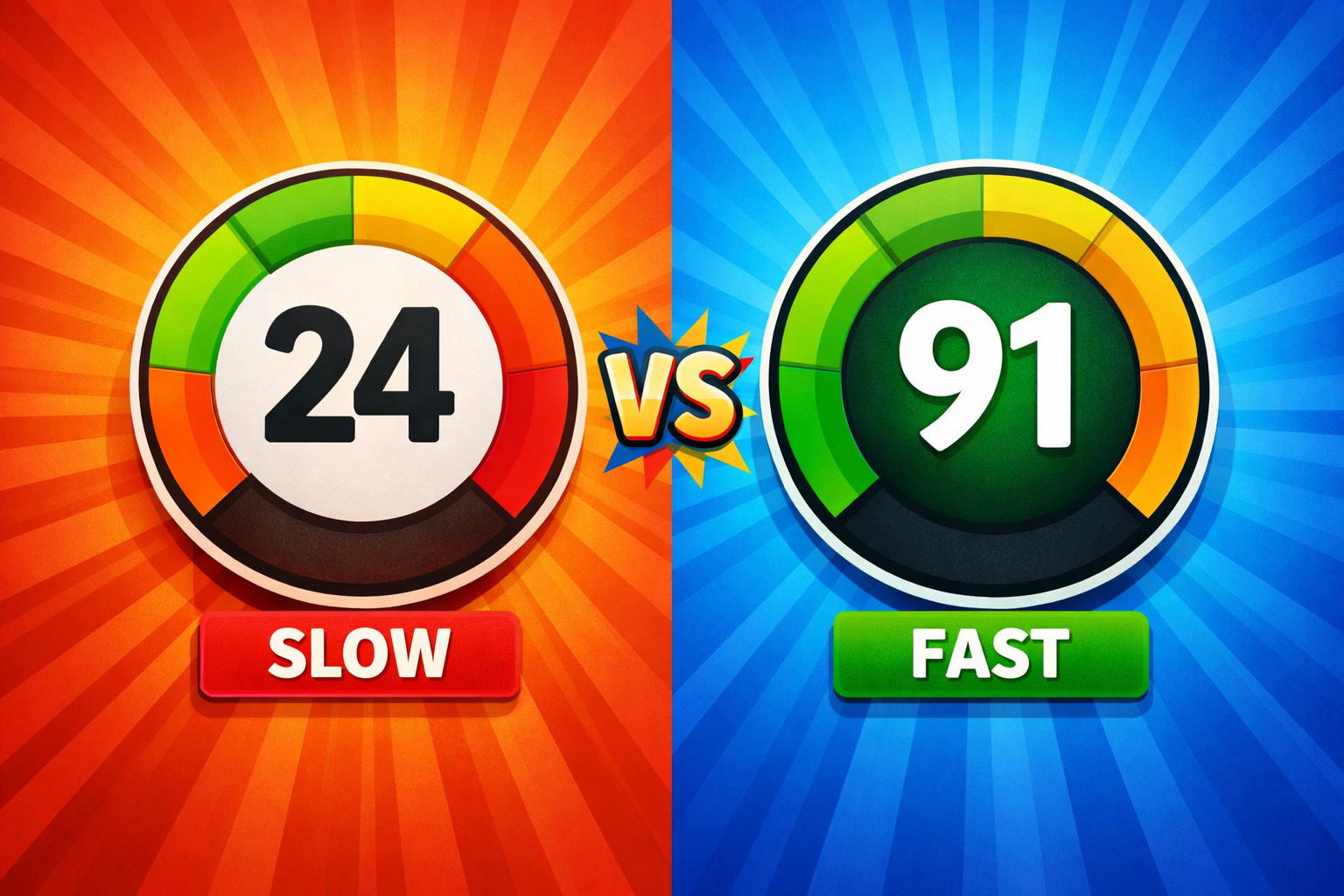
Score 50 to 89: Needs improvement — you are losing some visitors
Score 0 to 49: Poor — you are losing a significant number of visitors and Google is penalising your ranking
If your mobile score is below 70, this guide was written for you.
Why Website Speed Matters More in 2026 Than Ever Before
Website speed has always mattered for user experience. What changed is that Google made it an official ranking factor — and the standard it uses keeps getting stricter.
In 2021 Google introduced Core Web Vitals — a set of specific speed and experience metrics that directly influence where your website appears in search results. In 2026, these metrics are more heavily weighted than at any point before. A slow website does not just frustrate visitors. It actively gets pushed down the search rankings in favour of faster competitors.
For Mumbai businesses, the impact is compounded by one critical fact:
- Over 80% of Indian internet users access websites on mobile devices
- Mobile internet in India frequently runs on 4G rather than WiFi — meaning page load times on a phone are longer than on a desktop
- Indian mobile users have lower patience for slow loading than desktop users — research consistently shows faster abandonment rates
- A 1-second improvement in mobile load time increases conversions by up to 27% for retail sites
Put those facts together and the picture is clear. If your Mumbai business website loads slowly on a mid-range Android phone on a 4G connection — which describes the device and network conditions of the majority of your potential clients — you are losing a significant portion of your audience before they have seen a single word of your content.
The Real Business Cost of a Slow Website
Let us make this concrete with real numbers. Suppose your website receives 500 visitors per month — a modest number for any established Mumbai business. Your current mobile load time is 6 seconds. Here is what that means:
Scenario
Visitors Who Stay (est.)
Monthly Enquiries Lost
Load time: 1 to 2 seconds (fast)
475 out of 500 — 95% stay
Baseline — maximum opportunity
Load time: 3 seconds
400 out of 500 — 80% stay
75 visitors lost before seeing your content
Load time: 5 seconds
300 out of 500 — 60% stay
200 visitors lost — 40% of your audience gone
Load time: 7 seconds (slow)
175 out of 500 — 35% stay
325 visitors lost — two thirds of your audience
Load time: 10 seconds (very slow)
100 out of 500 — 20% stay
400 visitors lost — four fifths of your audience
If even 5% of your retained visitors become enquiries, the difference between a 2-second site and a 7-second site is the difference between 24 enquiries per month and 9. For a business where each client is worth Rs. 5,000 to Rs. 50,000, that gap is not a technicality — it is your most important business problem.
And this calculation does not even include the Google ranking impact. A slow site also appears lower in search results, meaning fewer people visit in the first place. The compounding effect of a slow website is significant and ongoing.
The 7 Most Common Causes of a Slow Mumbai Business Website
Most slow websites are slow for the same reasons. After auditing dozens of Mumbai and Navi Mumbai business websites, here are the problems we find most consistently:
Cause
What It Means
How Common
1
Uncompressed images
Photos uploaded at full resolution — a single photo can be 4 to 8MB. Mobile browsers must download all of it before displaying.
Extremely common — found in 90% of slow sites
2
No caching configured
Every time a visitor loads a page, the server rebuilds it from scratch. Caching serves a saved version instead — far faster.
Very common — most shared hosting has no caching by default
3
Too many plugins (WordPress)
Each plugin adds code that must load on every page. A WordPress site with 30+ plugins is typically slow regardless of hosting quality.
Very common — average Mumbai WordPress site has 24 plugins
4
Cheap shared hosting
Shared hosting puts your website on a server with hundreds of others. When other sites use resources, yours slows down.
Extremely common — most low-budget builds use Rs. 500/mo hosting
5
No content delivery network (CDN)
Without a CDN, every visitor downloads files from one server location. A CDN stores copies across multiple locations worldwide for faster delivery.
Common — rarely included in budget builds
6
Render-blocking JavaScript and CSS
Scripts that must fully load before the page can display anything. Poor coding practice that creates a blank screen while the user waits.
Common — usually a sign of outdated theme or plugin code
7
No lazy loading on images
Without lazy loading, all images on the page — including those far below the fold — load at once. Only images the user can actually see should load first.
Common — not enabled by default on most platforms
In most cases, fixing the top 3 causes alone — image compression, caching, and hosting — will improve a website's PageSpeed score by 30 to 50 points. A site that scores 28 on mobile can reach 75 to 80 by addressing only these three issues. This is why speed optimisation often delivers a disproportionately large improvement relative to the effort involved.
Understanding Google's Core Web Vitals — What They Mean for Your Mumbai Website
Google Core Web Vitals are the specific metrics Google uses to measure page experience. Understanding them helps you know exactly what to fix and in what order:
Metric
What It Measures
Good Score
What Causes a Poor Score
LCP — Largest Contentful Paint
How long before the main content of the page is visible
Under 2.5 seconds
Large uncompressed hero images, slow server response time
FID — First Input Delay
How long before the page responds to a tap or click
Under 100ms
Heavy JavaScript blocking the main thread
CLS — Cumulative Layout Shift
How much the page content shifts around while loading
Under 0.1
Images without dimensions, ads loading late, font swaps
INP — Interaction to Next Paint
Responsiveness of the page to all user interactions
Under 200ms
Unoptimised JavaScript, complex page interactions
TTFB — Time to First Byte
How quickly the server starts sending data to the browser
Under 800ms
Slow hosting, no caching, database query issues
You do not need to understand the technical details of each metric. What matters is knowing that Google checks all five of these every time it crawls your website — and that failing even one or two has a measurable negative impact on your search ranking. A web development company in Mumbai that builds with Core Web Vitals in mind from day one will produce a site that is faster, ranks better, and converts more visitors.
How to Test Your Website Speed Right Now — Free Tools
Before fixing anything, you need to measure accurately. Here are the four best free tools for testing a Mumbai business website's speed:
Real-device testing, filmstrip view showing page load frame by frame
Select a real mobile device and India location. Shows exactly what the user sees at 1s, 2s, 3s intervals.
Run your website through Google PageSpeed Insights first — it is the most direct signal of how Google evaluates your site. Then use GTmetrix to get the detailed breakdown of what specifically is causing slowness. These two tools together give you everything you need to prioritise fixes.
The 10-Step Speed Optimisation Checklist for Mumbai Business Websites
Work through this checklist in order. Each step is listed with the approximate impact it will have on your PageSpeed score and the complexity of implementation:
Optimisation Step
How to Implement
Score Impact
1
Compress all images
Use TinyPNG or ShortPixel to compress every image to under 150KB before uploading. Install ShortPixel plugin on WordPress to auto-compress on upload.
Very High — typically +15 to +30 points
2
Convert images to WebP format
WebP files are 25 to 35% smaller than JPG or PNG at the same visual quality. Enabled via ShortPixel, Imagify, or server-level configuration.
High — typically +5 to +15 points
3
Enable caching
Install WP Rocket or W3 Total Cache on WordPress. For Shopify, caching is handled automatically. For custom sites, configure server-level caching.
Very High — typically +10 to +25 points
4
Upgrade hosting to a faster plan
Move from shared hosting (Rs. 500/mo) to a managed WordPress host or VPS — Cloudways, Hostinger Business, or WPEngine start from Rs. 800 to Rs. 2,000/mo.
High — TTFB improvement is immediate
5
Enable a Content Delivery Network (CDN)
Cloudflare CDN is free and takes 10 minutes to set up. It serves your static files from a server closest to each visitor.
High — significant improvement for mobile users
6
Add lazy loading to all images
Add loading='lazy' attribute to all img tags. In WordPress, this is enabled by default since version 5.5. Verify it is active.
Moderate — typically +5 to +10 points
7
Minify CSS, JavaScript, and HTML
Use WP Rocket, Autoptimize, or your CDN to minify code files. Removes whitespace and comments from code — reduces file sizes by 10 to 30%.
Moderate — typically +5 to +10 points
8
Remove unused plugins and scripts
Deactivate and delete every WordPress plugin not being actively used. Each plugin adds load time even when inactive.
Moderate — depends on number removed
9
Set image dimensions in HTML
All images must have explicit width and height attributes. This prevents layout shift (CLS) — one of Google's Core Web Vitals metrics.
Moderate — primarily improves CLS score
10
Use a lightweight, performance-first theme
Heavy page builder themes like Divi or Elementor add significant overhead. Consider a lightweight theme like GeneratePress or Astra, or a custom-built theme.
High — can change score by 20+ points
Steps 1 to 5 deliver the majority of speed improvement for most Mumbai business websites. If you complete only these five steps, you will typically see your mobile PageSpeed score improve from a failing range to a passing or good range — and the ranking and conversion benefits follow within 2 to 4 weeks as Google recrawls the site.
What Speed Scores Mean for Your Google Ranking — The Direct Connection
Google confirmed in 2021 that Core Web Vitals are a ranking signal. In 2026, this signal has become more significant. Here is exactly how your PageSpeed score connects to your position in Google search results:
The Passing Threshold
A website that passes all Core Web Vitals — LCP under 2.5 seconds, FID under 100ms, CLS under 0.1 — receives a positive page experience signal. This does not guarantee page 1 ranking, but it removes a negative signal that is actively pushing your site down.
A website that fails Core Web Vitals has a negative signal applied. In a competitive market like central Mumbai, this negative signal is often the difference between position 8 and position 3. In lower-competition areas like Navi Mumbai, it can be the difference between page 1 and page 2.
Speed as a Tiebreaker
When two Mumbai websites have similar relevance — similar keywords, similar content quality, similar backlink profiles — Google uses page experience as a tiebreaker. The faster, more mobile-friendly site wins. This is exactly why businesses with newer, faster websites are increasingly outranking older, slower competitors even when the older business has more years of online presence.
Speed and Bounce Rate
There is an indirect but powerful connection between page speed, bounce rate, and Google ranking. When a slow website causes visitors to leave immediately — increasing bounce rate — Google interprets this as a signal that the page did not satisfy the searcher's intent. Over time, consistently high bounce rates contribute to lower rankings. Improving speed reduces bounce rate, which improves ranking signals in a compounding cycle.
Case Study: A Thane Business That Went From Score 21 to Score 88 in 2 Weeks
Case Study — Financial Advisory Firm, Thane, Mumbai
A financial advisory firm in Thane had a WordPress website built in 2022. The design was clean and professional. But the mobile PageSpeed score was 21 — in the failing range.
They were spending Rs. 12,000 per month on Google Ads because their organic rankings were poor. They assumed the problem was content or backlinks.
GarunaCDX conducted a speed audit. The actual problems were:
- Hero image: 5.8MB uncompressed JPEG
- 31 active plugins including 6 that were not being used
- Shared hosting on a server with 847 other websites
- No caching plugin active
- Elementor page builder with all animations enabled
- No CDN in place
What we fixed over 5 working days:
- All images compressed — hero image reduced from 5.8MB to 87KB (98.5% reduction)
- 8 unused plugins removed, 4 more replaced with lighter alternatives
- Hosting migrated from shared to Cloudways managed hosting
- WP Rocket caching configured with all recommended settings
- Cloudflare CDN enabled and configured
- Elementor animations disabled site-wide
- All images converted to WebP
Results:
- Mobile PageSpeed score: from 21 to 88 in 14 days
- LCP improved from 11.2 seconds to 1.8 seconds
- Google Search Console impressions: increased 34% within 30 days
- 3 keywords moved from page 2 to page 1 within 6 weeks
- Google Ads spend reduced from Rs. 12,000 to Rs. 7,000/month — same enquiry volume
- Cost of the speed optimisation work: Rs. 14,500
Case Study: A Navi Mumbai eCommerce Store That Doubled Mobile Conversion Rate
Case Study — Home Decor Online Store, Vashi, Navi Mumbai
A home decor eCommerce store in Vashi had been operating for 8 months with consistent traffic from Instagram but poor sales conversion. Analytics showed 2,200 monthly sessions and only 14 orders — a 0.6% conversion rate.
The owner assumed the products were not resonating. A speed audit revealed the real problem.
Mobile PageSpeed score: 34. Average mobile load time: 7.4 seconds.
The product pages had 12 to 18 large uncompressed product images each.
No lazy loading. No caching. No CDN. WooCommerce with 19 plugins.
GarunaCDX fixed the speed issues over one week:
- 340 product images compressed — average size reduced from 2.1MB to 94KB
- WebP conversion enabled site-wide
- Lazy loading configured for all product images
- LiteSpeed Cache installed and configured on the hosting server
- Cloudflare CDN enabled
- 7 redundant plugins removed
- Checkout page specifically optimised — removed all non-essential scripts
Results after 45 days:
- Mobile PageSpeed score: from 34 to 79
- Mobile load time: from 7.4 seconds to 2.3 seconds
- Monthly orders: from 14 to 31 — same traffic, doubled conversion rate
- Revenue: from Rs. 42,000/month to Rs. 93,000/month
- Cost of optimisation: Rs. 12,000
- Return on investment: achieved in under 3 weeks
The second case study is a powerful reminder that traffic is not the problem for most Mumbai businesses — conversion is. And conversion is directly tied to speed. The store did not need more Instagram followers or a bigger ad budget. It needed a website that did not drive its own customers away before they could buy.
How to Keep Your Website Fast — Ongoing Maintenance
Speed optimisation is not a one-time fix. Websites slow down over time as content is added, plugins are updated, and hosting environments change. Here is a simple monthly and quarterly maintenance routine to keep your Mumbai business website performing:
Frequency
Task
Time Required
Monthly
Run Google PageSpeed Insights on your homepage and top 3 pages. Note the scores.
10 minutes
Monthly
Check Google Search Console Core Web Vitals report for any new failures.
10 minutes
Monthly
Compress any new images uploaded that month using TinyPNG or ShortPixel.
5 minutes
Monthly
Delete any media library images not being used on any page.
10 minutes
Quarterly
Review and remove any plugins installed but not actively used.
15 minutes
Quarterly
Update all WordPress themes, plugins, and core — test for conflicts after updating.
30 minutes
Quarterly
Check hosting plan — if server response time (TTFB) has increased, consider an upgrade.
15 minutes
Annually
Full speed audit — repeat all 10 optimisation steps and assess what has changed over the year.
2 to 3 hours or hire GarunaCDX
Total monthly time: approximately 35 minutes. This small investment protects the speed improvements you have made and ensures your Google rankings are not gradually eroded by accumulating slowness over time.
When to Hire a Professional vs Fixing It Yourself
Some speed improvements are straightforward and can be done by any business owner — compressing images, installing a caching plugin, enabling Cloudflare CDN. Others require technical expertise and should not be attempted without developer involvement:
Do It Yourself (Low Risk)
Hire a Professional (Technical Complexity)
Compressing images before uploading
Migrating to a faster hosting provider
Installing and configuring a caching plugin
Diagnosing and fixing render-blocking scripts
Enabling Cloudflare CDN — free and guided setup
Fixing Core Web Vitals CLS issues in theme code
Deactivating and deleting unused plugins
Replacing a heavy page builder with a lightweight theme
Enabling lazy loading (WordPress 5.5+ does this automatically)
Server-level caching and compression configuration
Running PageSpeed Insights and Search Console monthly
Custom Next.js or React performance architecture
If your mobile PageSpeed score is below 50 and you are not comfortable with the technical column above, the most efficient path is a professional speed audit and optimisation. GarunaCDX offers standalone speed optimisation for existing Mumbai websites — with a written report of findings and a fixed price before any work begins.
Useful Links and Further Reading
Internal Links (Add to Blog)
External Authority Links
How to Rank on Page 1 of Google in Navi Mumbai [/blog/how-to-rank-on-page-1-google-navi-mumbai-2026]
Website Development Company Navi Mumbai [/website-development-company-navi-mumbai]
Cloudflare CDN Setup [cloudflare.com/cdn]
Frequently Asked Questions
Q1. What is a good website speed score for a Mumbai business website in 2026?
A Google PageSpeed Insights mobile score of 90 or above is excellent. A score of 70 to 89 is good and will not significantly hurt your rankings. A score of 50 to 69 needs improvement — you are losing some visitors and your Google ranking is being modestly penalised. A score below 50 is in the failing range and is actively costing you visitors, conversions, and ranking positions. For any Mumbai business that relies on Google for client enquiries, a score below 70 should be treated as an urgent business problem.
Q2. How much does website speed optimisation cost in Mumbai?
A professional speed optimisation service for an existing Mumbai business website — including image compression, caching setup, CDN configuration, and plugin audit — typically costs between Rs. 8,000 and Rs. 20,000 depending on the size of the site and the severity of the issues. Hosting migration is an additional cost if required — typically Rs. 3,000 to Rs. 8,000 for migration plus the new hosting plan cost. GarunaCDX provides a free initial assessment and a written quote with no obligation before any work begins.
Q3. Will making my website faster actually improve my Google ranking?
Yes — directly and indirectly. Directly, Google uses Core Web Vitals as a ranking signal. A website that passes Core Web Vitals receives a positive page experience signal that contributes to higher ranking. Indirectly, a faster website reduces bounce rate — because visitors stay longer when the site loads quickly. Google interprets lower bounce rate as a signal that the page is satisfying to users, which also contributes to better ranking over time. Most GarunaCDX clients see measurable ranking improvements within 4 to 8 weeks of a speed optimisation.
Q4. My website is on Shopify — can I still improve its speed?
Yes. Shopify handles core hosting performance well, but there are still significant speed improvements available on most Shopify stores. The most common issues are large uncompressed product images, heavy theme files from premium Shopify themes, too many third-party apps adding scripts, and missing lazy loading on product pages. Shopify's built-in image optimisation helps but does not replace properly sized source images. GarunaCDX has optimised Shopify stores from scores in the 40s to scores in the 70s and 80s without changing the platform.
Q5. How long does it take for speed improvements to affect my Google ranking?
Google recrawls most websites every 1 to 4 weeks depending on how frequently content changes. After a speed optimisation is complete, Google will typically pick up the improvements within 2 to 3 weeks. Ranking changes follow over the next 3 to 6 weeks as Google processes the updated crawl data. In competitive Mumbai markets, ranking improvements are more gradual. In lower-competition Navi Mumbai local searches, the ranking impact can be visible within 4 to 6 weeks of the optimisation going live.
Final Thoughts — Speed Is Not a Technical Problem. It Is a Business Problem.
Every second your website takes to load is a business decision — one that is currently being made by whoever last touched your code, your hosting plan, or your image files. If that decision was made without speed in mind, you are paying the cost every day in lost visitors, lower rankings, and missed enquiries.
The good news is that website speed is one of the most fixable problems in digital marketing. Unlike SEO, which takes months to show results, or paid ads, which stop the moment you stop paying — speed improvements are measurable within days, show up in rankings within weeks, and continue compounding in value indefinitely.
For a Mumbai small business, the return on a Rs. 12,000 to Rs. 18,000 speed optimisation is typically realised within the first month. After that, every month of improved performance is pure return on a one-time investment.
Is Your Mumbai Website Too Slow? Get a Free Speed Audit
GarunaCDX will test your website speed, identify every issue that is costing you ranking and conversions, and give you a written report with a fixed-price quote to fix it.